Pink Quill Plant
Botanical Name: Tillandsia cyanea
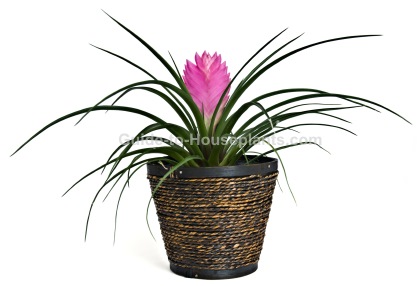
Pink Quill is a member of the bromeliad family of air plants, and gets its name from the plume of bright pink bracts that last for months.
Arching, narrow green leaves grow in a rosette with flower spikes appearing in summer. Its pink bracts are densely overlapping, with violet-blue flowers emerging for a brief show. Putting your plant on a plant stand while it's in bloom will give it all the attention it deserves.
What to Know About These Tropical Tree-Dwellers
Matching the bromeliad care in your home with that of their native rainforest habitat will keep them healthy.
Tillandsias are epiphytes in their native Ecuador and have small roots, mainly used for anchoring themselves on trees. Because the roots don't drink up water, these tree-dwelling plants gather moisture and nutrients through their leaves. Misting Pink Quill plant with water and foliar fertilizer will make it feel right at home.
Plants will bloom when they reach maturity, usually in 2-3 years. Like other bromeliads, they'll bloom once then produce offsets. Propagating the offsets will allow you to enjoy a collection for many years.
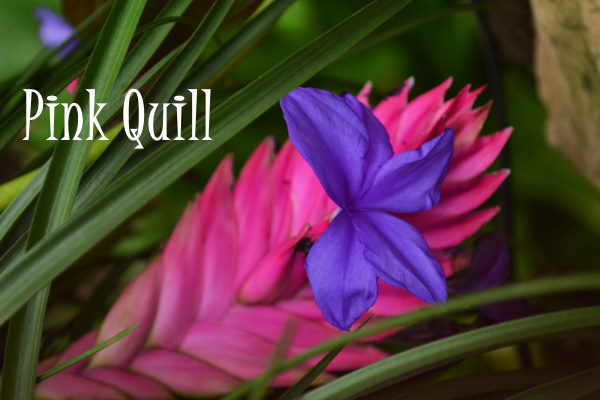 Given enough light, purple flowers will emerge between pink bracts. Photo ©Sylvia Lim
No flowers? Pink Quill plants that don't bloom aren't getting enough light. Move your plant closer to a window, but out of hot, direct midday sun. Brrr... keep this tropical native warm, too. It needs a temperature of about 75°F/24°C to flower.
Something bugging your bromeliad? Although pests are not common, it may get infested by scale insects, aphids or spider mites. Check regularly for pests and treat any infestation right away.
Pink Quill Plant Care Tips
Origin: Ecuador
Height: Newer dwarf cultivars only reach 10 in (25 cm) tall. Expect it to sprawl out, though. Its long, strappy leaves form a rosette up to 12 in (30 cm) wide.
Light: Bright, indirect light is needed to grow and bloom.
Water: Spray with water until leaves are thoroughly wet, 2-3 times a week. The water that runs off should be enough to wet the roots. Do not soak base of the plant, which can cause the flower stem to rot. Use rainwater or filtered tap water for misting your bromeliad. Soft water contains too much salt and some tap water contains chlorine and fluoride that can leave water spots on foliage.
Humidity: Average room (around 45% relative humidity). Brown tips on leaves are a result of dry air. The most efficient way to raise the humidity for tropical plants is with a cool-mist room humidifier.
Temperature: Average room temperatures 65-75°F/18-24°C suit this tropical bromeliad.
Soil: This is the only bromeliad from the Tillandsia genus that can be grown in a pot. It prefers a loose, fine-grade fir bark mix, such as an orchid mix or one specially labeled for bromeliads. Don't pack it down; keep the mix loose to allow air around the roots.
Fertilizer: Feed once a month in spring and summer with a foliar fertilizer spray specially made for Tillandsias.
Propagation: Remove offsets -- called pups -- that grow at the base of the plant when they are at least 3 in (7 cm) tall with a sharp knife and pot shallowly in fresh potting mix. They'll take about 3-6 months to root.
More to Explore


-
Hoya Kerrii Plant Care - Grow this Valentine Hoya Indoors
Feb 12, 26 10:48 AM
 Discover how to grow Hoya Kerrii as a house plant. This heart-shaped succulent slowly grows into a vine studded with hearts. Discover what it needs to bloom.
 -
Anthurium Plant Care - How to Grow Anthurium Andraeanum Indoors
Feb 07, 26 02:22 PM
 Anthurium plant is one of the world's most exotic tropical flowers. Discover Anthurium growing tips: sunlight, fertilizer, watering, repotting.
 -
Grow African Violet Plants Indoors: Saintpaulia Houseplant Care
Feb 02, 26 11:45 AM
No other flowering houseplant can match African violet plants ability to bloom for months on end. How to water, fertilize, repot, grow African violets indoors.