Money Tree Plant Care
Botanical Name: Pachira aquatica
Money tree plant care is easy. Just put it where it'll get some indirect sunlight. Water thoroughly and allow the soil to dry out a bit between waterings.
Its thin trunks are often braided by growers to add to its appeal. Each spoke-like leaf has 5-7 bright-green leaflets that lend a tropical vacay feel to any brightly lit room.
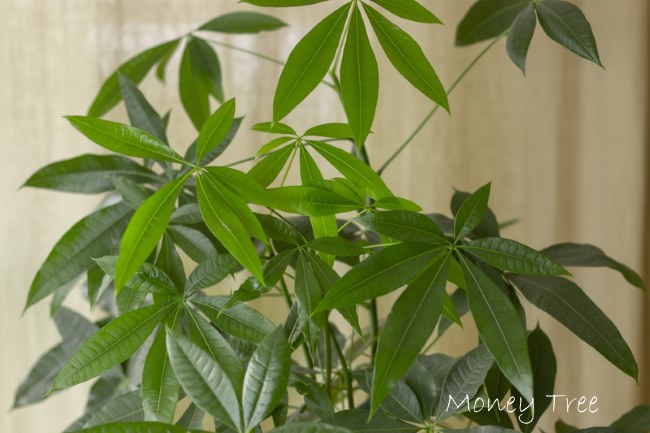 Money tree makes an easy-care houseplant. Photo ©Lennart Worthmann
Given enough sunlight, money tree does bloom, but you'll seldom see flowers on it indoors. Its natural bloom time is late spring through summer.
Wondering why Pachira aquatica is called money tree? According to feng shui, money tree will bring good luck and fortune. No, your money tree plant won't actually grow currency, but it is a good investment. Treat it well, and you'll enjoy this delightful tree for many years.
How to Take Care of Pachira aquatica Year-Round
Don't overpot. Use a smallish container because a too-big container will hold too much water. Soggy potting mix is often the biggest problem with this plant, causing stem and root rot and yellowing/dropping leaves. Growing money tree in a small container will also prevent it from getting too big. In fact, this tree can be grown as a bonsai. Regular pruning will also help control its size. Pinch or prune off growing tips.
Give it a winter rest. Keep your money tree warm and in bright light year-round. But cut back on water and stop fertilizing in the winter months because growth slows down with shorter daylight hours.
Brown, crispy leaves is a symptom of dry air or low light levels. Plants often are in shock when moved to a new home because they are adjusting to a new environment. Keep your plant away from heat/AC vents and cold drafts from windows and entryways.
Dropped leaves are also caused by relocation shock. If your new tree drops its leaves, don't give up on it. They'll grow back with good care. Place your money tree in a bright location and leave it there. Increasing humidity around the plant can help. While it's tempting to overwater a shedding plant, don't. It only makes the problem worse.
Money Tree Plant Care Tips
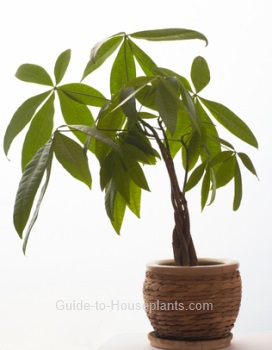
Origin: Wetlands in Central and South America
Height: Up to 10 ft (3 m) tall
Light: Find a bright spot for your money tree, out of direct sunlight, which can scorch its leaves. It thrives under fluorescent light, making this small tree an ideal office plant.
Water: Money tree plant likes water in big gulps. Water thoroughly, until water comes out the drainage holes in the bottom of the pot, then allow the top 1-2 inches (2.5-5 cm) to dry out between waterings. Take care not to allow the potting mix to get soggy, which can cause root rot. And avoid getting water on the trunk, which causes stem rot. Cut back on water in the winter when growth slows, but don't allow Money tree plant to dry out.
Humidity: This tropical native likes humid air. Try to keep the relative humidity at 50% or higher. Indoor air can become extremely dry during the winter months, so it's a good idea to use a humidity monitor rather than guess. To raise humidity near your plant, set the pot on a tray of wet pebbles or use a cool-mist room humidifier.
Temperature: Average room temperatures 65-80°F/18-27°C year-round. Keep your houseplant away cold doorways and from heat/AC vents.
Soil: Use a peat moss-based potting mix with perlite or sand added for good drainage.
Fertilizer: Feed every 2 weeks in spring and summer with an all-purpose water-soluble fertilizer diluted by half.
Propagation: Seeds or stem tips. Take stem tip cuttings in spring, with at least 2 leaf nodes attached. Dip the cut end in rooting hormone powder then insert it in moist potting mix. Be patient -- it can take several weeks to root.
More to Explore


-
Phalaenopsis Orchid Care: How to Make Phals Bloom
Apr 30, 26 04:15 PM
 Phalaenopsis orchid care. Beautiful and exotic, this is the easiest for growing orchids indoors. Find a profile and indoor orchid care instructions here.
 -
Calathea 'White Star' Houseplant Care
Apr 08, 26 11:31 AM
 Discover how to grow Calathea majestica 'White Star' indoors, including how much sunlight, water, and humidity it wants, plus when to repot and more.
 -
Philodendron Brasil Care: How to Grow this House Plant Indoors
Apr 01, 26 07:24 PM
 Discover how to grow Philodendron Brasil indoors. Train it to climb, or allow it to trail. You'll love showing off this variegated houseplant.


