False Aralia Indoor Care
Botanical Name: Dizygotheca elegantissima
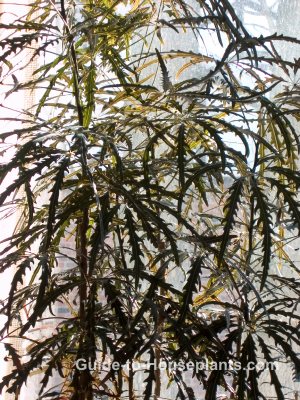
False Aralia has slender leaflets that grow in a circle at the tops of stems so that they look like fingers, giving this house plant another common name: Finger Aralia.
New coppery brown foliage turns a dark, blackish-green as the plant matures. Its narrow, serrated leaflets give this small tree a lacy appearance, adding elegance to a collection of tropical house plants.
Small plants look gorgeous in dish gardens, adding an upright palm-like form to the grouping. Put one with other tropical plants that like humidity, such as heartleaf philodendron or nerve plant. Seedlings will thrive in a terrarium under fluorescent light.
How tall does it get? Although slow-growing, this tropical plant will grow about 6 ft (1.8 m) tall when grown in a pot indoors. Mature plants make magnificent floor plants.
Buying Tips
This popular houseplant seems to suffer an identity crisis. Perhaps it got off to an unfortunate start by being called False Aralia.
It has taken on quite a few aliases.
Although best known as Dizygotheca elegantissima, the botanical name has been changed a couple times to Schefflera elegantissima then Plerandra elegantissima.
You'll sometimes find it for sale as Finger Aralia or Spider Aralia.
Some cultivars are available. 'Galaxy' has fewer yet broader leaf segments than the species. 'Galaxy Variegated' has leaflets beautifully edged in creamy white. 'Gold Crest' has leaflets stunningly edged in gold.
It's well-worth seeking. With good care, it's a long-lived plant and a striking accent.
False Aralia Problems, Solutions and Answers
Leaf drop. False Aralia likes to stay put. Moving it to a new location may cause its leaves to drop. It doesn't respond well to changes in light and temperature. Shedding leaves may also indicate that humidity is too low. Stand the pot on a tray of wet pebbles or use a cool-mist room humidifier. Raising the humidity also helps to prevent spider mites that may invade this plant.
Pruning. False Aralia is slow-growing and doesn't need pruned unless you want to control its height. Over time, it will drop its lower leaves, revealing a single tree-like trunk. If you want, you can keep it short and shrubby by cutting it back each year. Don't be afraid to prune it to 6 inches (15 cm) from the soil level. Spring is the best time to cut it back. New offsets will grow from the base of the plant.
Repotting. Repot in spring only when it has outgrown its pot, but use the smallest container that will hold its roots. It grows best when its roots are confined. Taller plants should be potted in a heavy container to prevent toppling.
 Slender, serrated leaflets give False Aralia lots of interesting texture. Photo ©Khairil Junos
Is False Aralia poisonous? No -- it's safe for a home with children and pets.
Something bugging your plant? Watch for spider mites that are attracted to dry conditions in winter. You can help prevent an infestation by raising the humidity near your houseplant. Also watch for mealybugs that look like white, fuzzy specks. They tend to be in groups along the stems, hidden near the base of the leaflets. Isolate an infested plant and treat it right away with a solution of insecticidal soap.
False Aralia Care Tips
Origin: South Pacific
Height: This Pacific Island native can grow to 20 ft (6 m) in the wild, but indoors this tree will slowly reach about 6 ft (1.8 m).
Light: For a lush, bushy plant, give False Aralia plenty of bright light, but no direct sun. Too much sun exposure may cause leaf edges to turn brown. Don't have a sunny spot for it? Grow False Aralia under a compact fluorescent (CFL) grow light. Keep your plant around 8 inches (20 cm) below the light source for 12 hours a day. You can make it easy on yourself by using a power strip with a timer to turn the grow light on and off at the same time each day.
Water: Water thoroughly and allow top 1 in (2.5 cm) of soil to dry out between waterings. Wilted leaves are a sign of overwatering.
Humidity: Moderate to high (around 50% relative humidity or above). Indoor humidity can drop drastically during the winter months, without our noticing it. It's a good idea to use a humidity monitor, rather than guess. Fortunately, boosting humidity for your tropical houseplants is easy. The most efficient way to increase humidity is with a cool-mist room humidifier.
Temperature: Keep plant warm (65-85°F/18-29°C) year-round. Do not expose this tropical native to temperatures below 60°F/16°C, which can cause leaf drop. Keep your plant away from drafty entryways and heat/AC vents, because they can change temperature and humidity levels.
Soil: All-purpose houseplant potting mix
Fertilizer: Feed every 2 weeks with a balanced water-soluble fertilizer (such as 10-10-10 NPK) diluted by half. In fall and winter, feed monthly.
Propagation: Seeds or stem tip cuttings. Take stem tip cuttings in spring. For best results, dip cut end in hormone rooting powder before inserting in moist potting mix. Cover with a plastic bag to raise the humidity around the cutting. Keep it warm and out of direct sunlight.
More to Explore


-
Paperwhite Narcissus - Forcing Paperwhites Indoors and Care Tips
Dec 02, 25 11:00 AM
 Find out how to force paperwhite narcissus into bloom indoors. Growing paperwhite bulbs is easy with these step-by-step tips, plus how to make the flowers last.
 -
Christmas Cactus Care: Grow Schlumbergera Bridgesii Indoors
Dec 01, 25 11:11 AM
Christmas cactus care will keep your plant healthy and blooming year after year. How to prune, repot, fertilize, propagate and get Christmas cactus to re-bloom. -
Fiddle Leaf Fig House Plants: How to Grow Ficus Lyrata Indoors
Nov 26, 25 11:41 AM
 Fiddle Leaf Fig tree gets its name from its big, fiddle-shaped leaves. Find out how to grow this beautiful ficus tree indoors and keep your houseplant thriving.