Growing Croton Plants Indoors
Botanical Name: Codiaeum variegatum pictum
Croton plants stiff, leathery leaves in bold colors of yellow, pink, red, orange and green make it a beautiful and popular house plant. Its varied colors give it another common name, Joseph's Coat.
The croton plant shown here is one of the most dramatic we've seen. Warm tropical colors and exotic patterned leaves make 'Petra' a knockout in any brightly lit room.
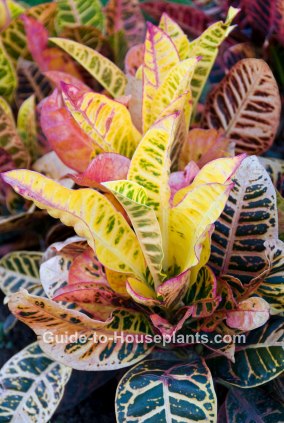
I don't know of any houseplant that will give you more bang for your buck than this one. Those vibrant colors will rival just about any flower you could name.
Crotons are not easy to please. The keys to success are plenty of sunshine, a warm, draft-free environment, moist soil, and humid air. Dry air and soil will cause croton leaves to fall off. Give croton what it wants and you'll enjoy this tropical beauty a long time.
Croton Problems, Solutions and Special Care
Clean 'em up. Keep leaves dust-free and shiny by gently wiping them with a damp cloth. Don't use leaf-shine products, mayo, or any other shine solution you may have heard about. Croton leaves are naturally slick and shiny.
Give them space. If you bought a container that has 2 or 3 plants in it (which is fairly common), keep them together for the first year or so. When the plants seem crowded, give them the space they need by separating them. Divide croton plants by carefully cutting through their roots with a serrated knife, then pot each plant in its own container.
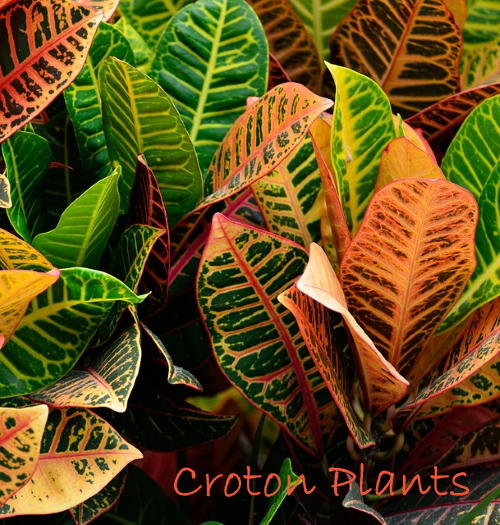
Too tall? Top them. Croton plants are naturally bushy, so they shouldn't need pruning. If they get too big, you can cut them back in spring and propagate the stem cuttings.
To repot...or not? Repot in spring, moving to a pot only 1 size larger. You can control croton plant's size by keeping it in the same container, so that its roots are confined. Get the steps to repotting your houseplant here. When the plant reaches the size you want, top-dress annually instead.
How to Top Dress: Remove the top 2-3 inches of soil and replace with fresh soil every couple years. Take care not to harm any roots that may be near the surface.
Why are croton leaves falling off? Croton may drop a couple leaves when you bring it home -- it's adjusting to its new environment. If your plant continues to drop leaves, it's likely caused by a lack of sunlight or dry soil. See "Light" and "Water" tips below. Keep the plant out of drafts and away from heat/AC vents. Raising the humidity can help. For best results, use a cool-mist room humidifier near the plant.
Something bugging your plant? Mealybugs are white and fuzzy, looking like specks of cotton along the leaf axils or stems. Red spider mites are so tiny, all you'll see is the fine webbing between leaves and stems. These sap-sucking pests may cause yellow, dry spots on leaves. Treat any infestation right away to prevent these pests from moving to your other indoor plants.
Are croton plants poisonous? Oh, yes. A member of the Euphorbia family, this plant has poisonous sap. Don't be afraid of crotons, but take some precautions. Keep croton away from children and pets and wear gloves while handling it.
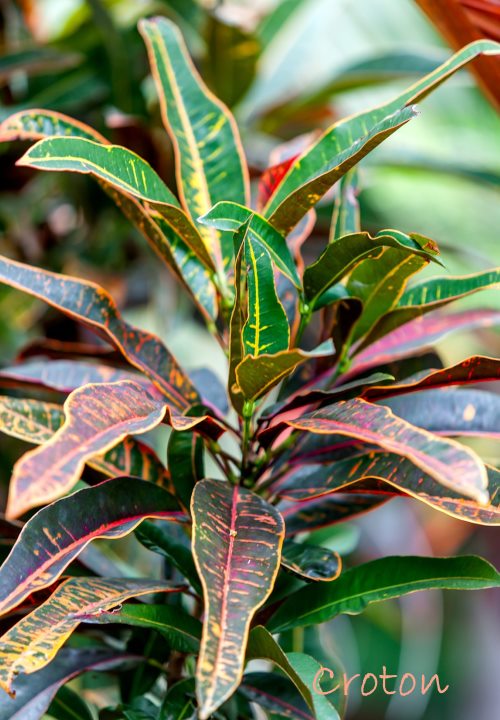 Photo Credit: Robert Waghorn/Pixabay
Types of Croton Varieties
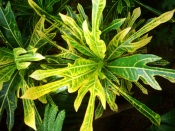
Many cultivars are available, and their colors and shapes vary enormously. 'Golden Bell' is a newer hybrid, featuring long, narrow leaves that are mostly green and yellow. 'Bravo' has lobed leaves with yellow veins. The most common variety is 'Petra' splashed with vibrant colors.
New varieties are being introduced, including some with curved, twisted and even corkscrew leaves. Some are spotted, speckled or streaked. 'Gold Dust' has small leaves, heavily spotted with yellow. Banana croton sports twisted, yellow-and-green leaves.
Arrowhead croton (shown above) has unusual leaves that add contrast to a group of plants.
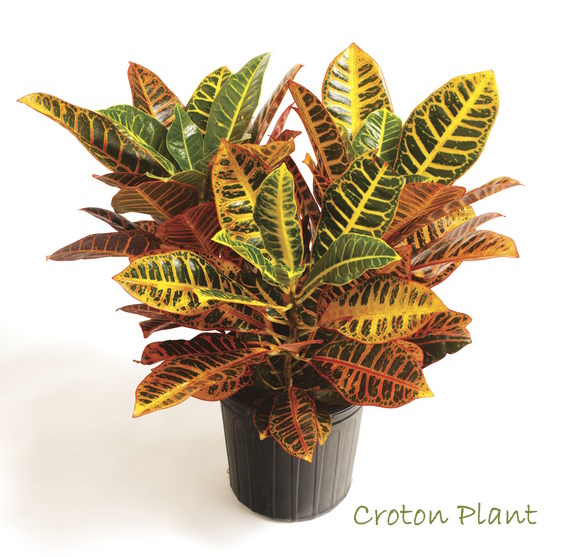 Photo istockphoto.com
Caring for Croton Plants Indoors
Origin: Pacific Islands, Malaysia, Northern Australia
Height: Up to 3 ft (90 cm), depending on variety. When allowed to grow tall, crotons have a tree-like form with thick trunks.
Light: Bright light and at least 3 hours of direct sun each day. Leaf color is most vibrant when the plant is getting lots of light. If new leaves are mostly green, move the plant to a brighter location. A lack of sunlight can cause croton to drop its leaves. Don't test it on this -- I had one that dropped all of its leaves when I left it in a less-than-sunny location.
Water: Keep soil mix evenly moist with tepid water. It's a good idea to use a pot with drainage holes. Water thoroughly, then empty the drainage saucer. Water less in winter, when growth is slower, but don't allow the potting mix to dry out.
Humidity: Aim to maintain relative humidity around 60% or higher around plant. Stand pot on a tray of wet pebbles or use a cool-mist room humidifier.
Temperature: Average to warm room temperature (65-85°F/18-29°C) year-round. Don't expose this tropical native to temperatures below 60°F/16°C.
Soil: Peat moss-based mix, such as African violet potting mix.
Fertilizer: Feed every 2 weeks from early spring through summer with a balanced liquid or water-soluble fertilizer, diluted by half.
Propagation: Take stem cuttings in spring and dip in rooting hormone before inserting in a half-half mix of sand and peat moss-based potting mix. Croton cuttings root in about a month.
More to Explore


-
Paperwhite Narcissus - Forcing Paperwhites Indoors and Care Tips
Dec 02, 25 11:00 AM
 Find out how to force paperwhite narcissus into bloom indoors. Growing paperwhite bulbs is easy with these step-by-step tips, plus how to make the flowers last.
 -
Christmas Cactus Care: Grow Schlumbergera Bridgesii Indoors
Dec 01, 25 11:11 AM
Christmas cactus care will keep your plant healthy and blooming year after year. How to prune, repot, fertilize, propagate and get Christmas cactus to re-bloom. -
Fiddle Leaf Fig House Plants: How to Grow Ficus Lyrata Indoors
Nov 26, 25 11:41 AM
 Fiddle Leaf Fig tree gets its name from its big, fiddle-shaped leaves. Find out how to grow this beautiful ficus tree indoors and keep your houseplant thriving.