Venus Fly Trap
Botanical Name: Dionaea muscipula
In its native habitat, the Venus Fly Trap plant grows in bogs where it is unable to get the nutrients it needs from the soil. Therefore, it has developed a way to feed from the insects it traps in its leaves.
Feed Me?
This bug-munching plant makes food by photosynthesis, so feeding it insects is not critical for its survival. But isn't that the fun of growing this captivating house plant?
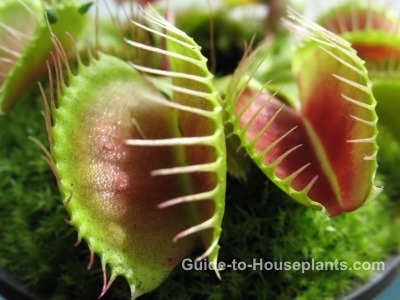
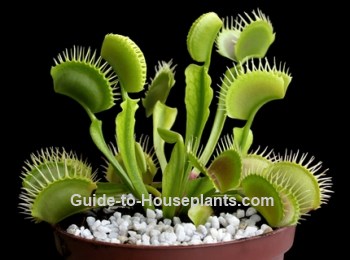
This unusual, carnivorous plant grows in a rosette of broad-winged stems, each with 2 rounded leaves that turn red inside when exposed to sunlight.
The leaves are hinged in the middle by a midrib and fringed with interlocking "teeth" to hold in its prey.
Inside each leaf are a few sensitive hairs that when touched trigger the leaves to snap shut. The action is quick, and the traps may stay closed for as long as 2 weeks. Then they open again, ready for the next victim. Heh, heh.
Although it's fascinating to watch, try not to get overzealous. It's not a good idea to trigger them too often because the traps will stop responding after only a few times.
Clusters of white flowers may appear in spring. Pick off the flower stems as soon as you see them because they will use the plant's energy to flower instead of growing traps.
Venus Fly Trap is a perennial plant that can be kept from year to year. Understanding its needs for moisture and light will keep it healthy. Never allow the potting medium to dry out, which can be fatal.
D. muscipula will go dormant in winter when a cool rest is needed. Keep it barely moist and cool during dormancy, with temperatures between 32-50°F/1-10°C. Moving it to a garage for the winter may be ideal...just be sure it gets some sunlight and the temps don't drop below freezing.
Venus Fly Trap Care Tips
Origin: North and South Carolina
Height: 3-10 in (8-25 cm)
Light: Good light is vital to this plant's health. Bright light with 4 hours of direct sun a day is ideal. Sunlight is more important than feeding the plant because it makes most of its food through photosynthesis.
Water: Keep soil evenly moist spring through fall. In winter, give it just enough water to keep from drying out completely. This plant is sensitive to chemicals in tap water, so it's a good idea to use only distilled or rain water. If stems and leaves become limp, it means that the soil is too dry. Water thoroughly, although the plant may not recover.
Humidity: Prefers moderate (around 50% relative humidity) or higher. Use a humidity tray, cool-mist room humidifier, or an open terrarium to maintain moist air around your plant.
Temperature: Normal room temperatures (60-75°F/16-24°C); In winter, a near-freezing dormancy period is needed (32-50°F/1-10°C).
Soil: Use nutrient-poor soil because rich potting mix will harm its roots. You can use all sphagnum moss or mix 1 part peat moss with 1 part perlite.
Fertilizer: Don't fertilize. Fertilizer will burn the roots and may kill the plant. Since it is unlikely to catch insects in the house, you can feed it dead flies occasionally in spring and summer. Don't use flies that have been exposed to insecticide because it will harm the plant.
Propagation: Divide rhizomes in spring; can be grown from seed.
Recent Articles


-
Anthurium Plant Care - How to Grow Anthurium andraeanum Indoors
Apr 17, 24 12:25 PM
 Anthurium plant is one of the world's most exotic tropical flowers. Discover Anthurium growing tips: sunlight, fertilizer, watering, repotting.
 -
Goldfish Plant Care Tips: How to Grow Columnea Gloriosa Indoors
Apr 15, 24 10:38 AM
 Goldfish Plant care for this amazing house plant. Find out how to get the most blooms, plus how and when to prune, water and fertilize.
 -
Inch Plant Care: Grow Trailing Tradescantia Zebrina as a Houseplant
Apr 15, 24 10:25 AM
 Get the keys to Inch Plant care with this easy guide. Glistening purple and green striped leaves make this stunning trailing plant ever-popular.