Growing Thyme Herb Indoors
Growing thyme indoors allows you to have a ready supply of this culinary herb all year long.
Here you'll discover how to grow sun-loving thyme on your windowsill or under a grow light. I'll tell you which varieties of this aromatic herb are best for cooking, plus -- when to water, harvest, and more.
Get to Know Thyme
Known botanically as Thymus vulgaris, this herb has origins in the Western Mediterranean.
Thyme is a hardy perennial. It is a low-growing, shrubby herb that may reach 6-12 inches (15-30 cm) in height, depending on the variety.
All varieties grow in a mound of many-branched woody stems covered with small, oval gray-green leaves. In early summer, you can expect clusters of light pink to lavender flowers to grow at the tips of the branches.
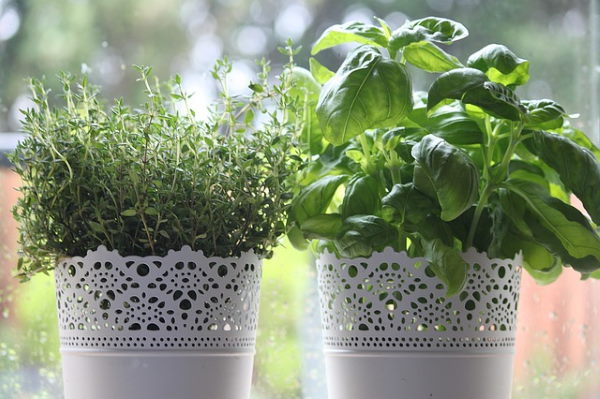 Growing thyme alongside basil in a sunny window. Image by Justyna Kunkel
Varieties of Thyme Herb
Among the most popular varieties for culinary use are common thyme, lemon, English, and French.
Thyme has an earthy, fresh fragrance and flavor that enhances many hearty dishes, breads and vinegars. It is one of the essential herbs used in Italian and French cuisine.
The best varieties for cooking are Common thyme (Thymus vulgaris) has the classic thyme aroma and flavor. 'Broad Leaf English' has wider, flatter leaves than the genus. 'Fine Leaf French' is a culinary classic with narrow, pointed gray-green leaves.
Lemon thyme (T. x citriodorus) is a hybrid with a strong lemony aroma. Two variegated cultivars of lemon thyme are 'Argenteus' with silvery green foliage edged in white, and 'Aureus' featuring bright green leaves edged in creamy yellow.
Harvesting Thyme Tip:
Young plants should be harvested sparingly the first year until they get established. Thereafter, snip foliage as needed during the summer. If you want to harvest bunches of it at a time, leave at least 3 inches (7.5 cm) of stems for regrowth.
How to Preserve Thyme Herbs
How to dry thyme: Cut off stems and tie in 1 inch bunches with string, leaving a loop for hanging. Hang them upside down and allow them to dry naturally in a cool, dry, dark place. Or you can strip the leaves and dry them on a screen.
Thyme freezes well and is a great way of preserving thyme for cooking. Strip leaves from the stems and place them in air-tight freezer bags.
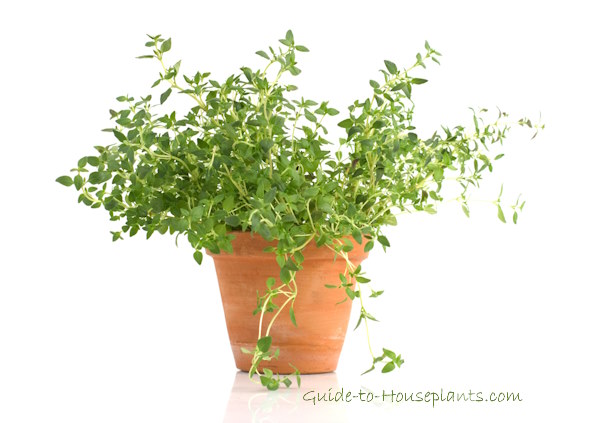 Image credit jaroon / istockphoto.com
Tips for Growing Thyme
Light: Full sun. Give your thyme plant least 6 hours of direct sun per day. Turn the plant for even growth because it will tend to grow toward the light source. If growing thyme under fluorescent light, keep the light 6 in (15 cm) above the plant and leave it on for 14 hours a day. This is the equivalent of 6 hours of sun.
Water: Water thoroughly then allow top 1 in (2.5 cm) of the soil to dry out between waterings.
Humidity: Average room (around 40% relative humidity).
Temperature: Average room temperatures 65-75°F/18-24°C
Soil: Sandy, well-drained soil, such as cactus mix. Or use 2 parts all-purpose potting mix with 1 part horticultural sand or perlite.
Fertilizer: Feed monthly spring through fall with an organic herb fertilizer according to package directions. Don't fertilize in winter, because there is little growth during those months.
Propagation: Sow thyme seeds in a seedling flat, using sterile seed-starting mix. Seeds are tiny and don't need to be covered with mix; just scatter seeds on top of moistened mix. Maintain 70°F/21°C temperature -- it's a good idea to use a seedling heat mat to maintain even warmth. Seeds are slow to germinate; expect about 15-20 days for germination.
Recent Articles


-
Begonia Care: Grow Tuberous Begonia Hybrids Indoors
Apr 23, 24 12:10 PM
 Get begonia care and grow Reiger begonia and other tuberous hybrids as houseplants. Discover how to get the most flowers and rebloom your begonia.
 -
Campanula Flowers Make Gorgeous Houseplants
Apr 20, 24 01:07 PM
 Campanula flowers look best spilling over a tall pot. Get tips for growing campanulas indoors, how to get the most blooms, when to repot, and more.
 -
Anthurium Plant Care - How to Grow Anthurium andraeanum Indoors
Apr 17, 24 12:25 PM
 Anthurium plant is one of the world's most exotic tropical flowers. Discover Anthurium growing tips: sunlight, fertilizer, watering, repotting.