Air Plant Care
Botanical Name: Tillandsia ionantha and other Tillandsia species
Air plant is epiphytic, meaning that it lives by absorbing water and nutrients through its leaves, rather than from soil.
In its native Central and South America, Tillandsia grows on trees, using its small roots to anchor itself on a tree branch. Because of its aerial lifestyle in the tropics, this type of epiphyte should not be planted in ordinary potting mix which will cause its small roots to rot.
Air plants can be grown in crevices or depressions of a gnarled piece of wood, wired onto a twig wreath with enameled florists' wire, or tucked into a seashell. Put the plant's roots on sphagnum moss to keep them from drying out. Do not use treated wood, or driftwood that may contain sea salt.
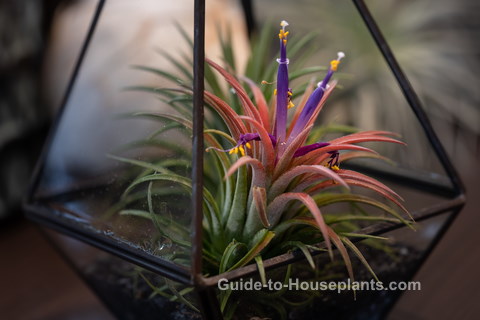 Small terrarium cases, shown here, make an easy home for Tillandsia ionantha.
These rootless wonders allow many creative possibilities for how to grow them. Stylish Tillandsia arrangements are sure to grab attention wherever you display them. I'm loving mine.
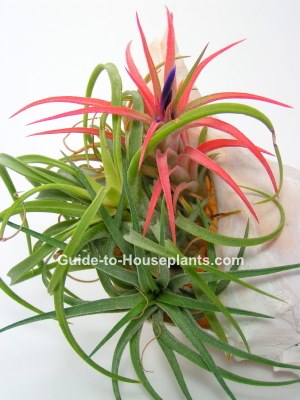
This tropical house plant from the Bromeliad family grows in a rosette of arching thin, green leaves, with deep pink or red plume-like bracts, and violet-blue flowers that appear in summer.
No blooms? Tillandsias that don't bloom are likely just too young. You can expect your plant to bloom when mature, which can take about 3 years. Another reason for no flowers is lack of sufficient light. Move your air plant to a brighter location, but avoid hot, direct sun which can scorch the foliage.
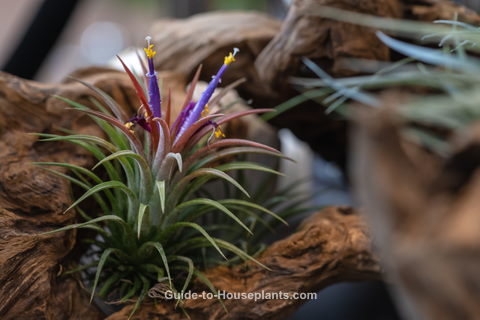 Grow Tillandsia ionantha on a piece of wood, just like its native habitat.
Air plants love air. Big surprise. Putting them in a spot where they'll get good air circulation allows the leaves to dry between waterings, just as they would in the wild. An open window (when it's warm) or a ceiling fan can help.
Tillandsia only lives for about 5 years, then deteriorates after blooming. However, it grows offsets -- called pups -- around the parent plant. Leave these pups attached until they are about half the size of the parent plant. Propagating pups will give you an ongoing collection of beautiful plants.
Air Plant Care Tips
Origin: Central and South America
Height: 6-12 in (15-30 cm)
Light: Bright, indirect light. These tropical beauties also thrive under fluorescent lights, making them good office plants.
Water: Spray plants twice a week, until they are thoroughly wet. Or you can take them to the sink and run tepid water over them. DO NOT soak them. Turn plants upside down to allow excess water to run off. Standing water at the base of the leaves will cause them to rot.
Humidity: Moderate to high -- 50% relative humidity or above. Brown leaf tips are caused by dry air. Use a humidity tray, cool-mist room humidifier or mist the plants with tepid water.
Temperature: Spring through early fall, average to warm 65-80°F/18-27°C. In winter, a cool rest 60°F/16°C will help it bloom the following summer.
Soil: None needed
Fertilizer: Feed once a month with foliar fertilizer specially made for air plants.
Propagation: Detach offsets when they reach half the size of the parent plant.
Recent Articles


-
Anthurium Plant Care - How to Grow Anthurium andraeanum Indoors
Apr 17, 24 12:25 PM
 Anthurium plant is one of the world's most exotic tropical flowers. Discover Anthurium growing tips: sunlight, fertilizer, watering, repotting.
 -
Goldfish Plant Care Tips: How to Grow Columnea Gloriosa Indoors
Apr 15, 24 10:38 AM
 Goldfish Plant care for this amazing house plant. Find out how to get the most blooms, plus how and when to prune, water and fertilize.
 -
Inch Plant Care: Grow Trailing Tradescantia Zebrina as a Houseplant
Apr 15, 24 10:25 AM
 Get the keys to Inch Plant care with this easy guide. Glistening purple and green striped leaves make this stunning trailing plant ever-popular.